
What Does Better Connectivity Actually Mean?

Connectivity is a word we use a lot in transport. But what does being better connected actually mean for the people and places we are planning for?
It's easy to think about connectivity in terms of infrastructure: faster journey times, new routes, more frequent services or better links between different modes of transport.
All of those things matter. But perhaps the more important question is: what does that improved connection enable someone to do?
For one person, better connectivity might mean being able to access a job without relying on a car. For another, it could mean reaching education or healthcare more easily. For a rural community, it might simply mean having a realistic and affordable way to reach the nearest town.
And when we look at the priorities emerging across different Combined Authorities, it becomes clear that connectivity is about much more than transport alone.
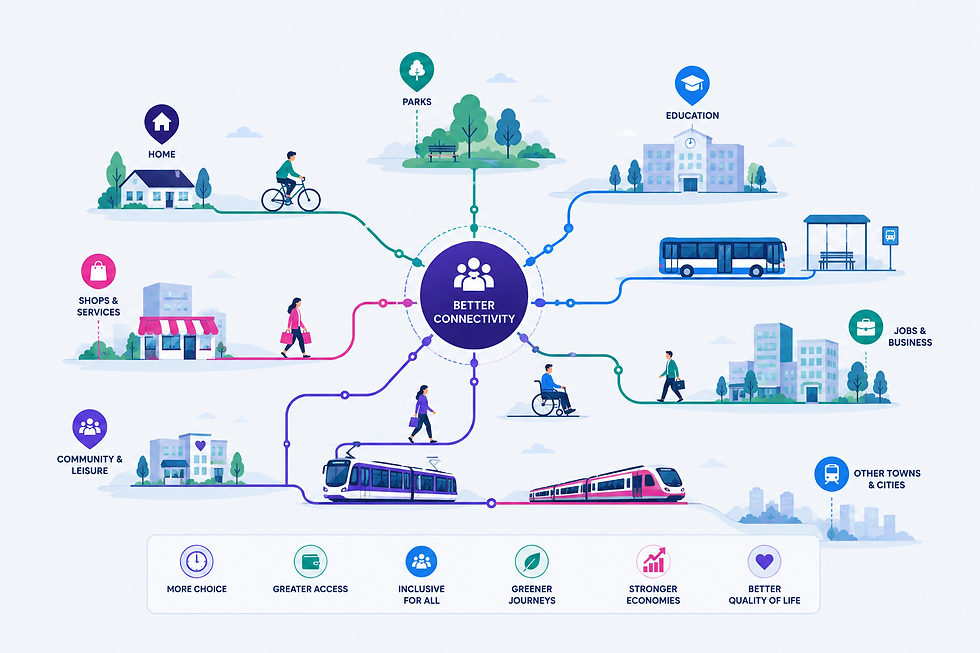
Connectivity means different things in different places
Places have different characteristics, challenges and ambitions and their approach to connectivity needs to reflect that.
In West Yorkshire, for example, the conversation around connectivity sits alongside ambitions for an integrated transport network, inclusive economic growth, mass transit, active travel, decarbonisation and healthier, greener communities.
For York & North Yorkshire, connecting rural and urban communities brings a different set of considerations. Accessibility, affordability and practical transport choices become particularly important when thinking about how people can access opportunities and essential services across a large and diverse geography.
In the East Midlands, integrated transport and improved connectivity are closely linked with giving residents better travel choices, connecting people with opportunities and supporting wider regional growth.
And in Tees Valley, connectivity has an important role to play in supporting investment, regeneration, employment and economic transformation.
These are different places with different challenges, but there is a common thread:
Transport connectivity isn't simply an end in itself. It's an enabler of wider outcomes.
A connection on a map isn't necessarily a useful connection
This is where understanding local context becomes particularly important.
A bus route might connect two places geographically, but does it operate when people need it?
Is it affordable?
Can everyone use it?
Does it connect effectively with the next stage of someone's journey?
And, perhaps most importantly, does it connect people with the opportunities and services they actually need?
The answers will look very different in a city centre compared with a market town, rural village or community on the edge of an urban area.
Good connectivity therefore requires us to look beyond individual modes and consider the whole journey.
From transport outcomes to place outcomes
Perhaps we also need to think differently about how we measure the success of connectivity.
Journey times, frequencies and passenger numbers remain important, but better connectivity can contribute to much wider outcomes.
It can help:
Connect people with employment, education and essential services
Support inclusive economic growth and regeneration
Improve accessibility and social inclusion
Give people realistic and affordable travel choices
Support healthier communities
Enable sustainable growth and decarbonisation
Unlock investment and support local economies
Which of these matters most will depend on the place.
That's why transport planning shouldn't begin with a predetermined solution. It should begin by understanding the people, place and outcomes we're trying to support.
Evidence helps us understand where connectivity matters most
Good evidence has an important role to play in answering those questions.
Understanding how people currently travel, where gaps in provision exist, which communities experience poorer accessibility and where investment could create the greatest benefits can help turn broad ambitions around connectivity into practical decisions.
And increasingly, bringing together transport data with demographic, economic, accessibility and behavioural evidence gives us an opportunity to understand not just where people travel, but why those connections matter.
For us at Nota Bene, that's an important distinction.
Whether the ambition is connecting rural communities, supporting regeneration, enabling inclusive growth or creating a more integrated and sustainable transport network, the starting point should be the same:

Who are we trying to connect?
What are we connecting them to?
And what outcome are we ultimately trying to achieve?
Because better connectivity shouldn't simply mean more transport.
It should mean better access to opportunity and better outcomes for people and places.


Comments